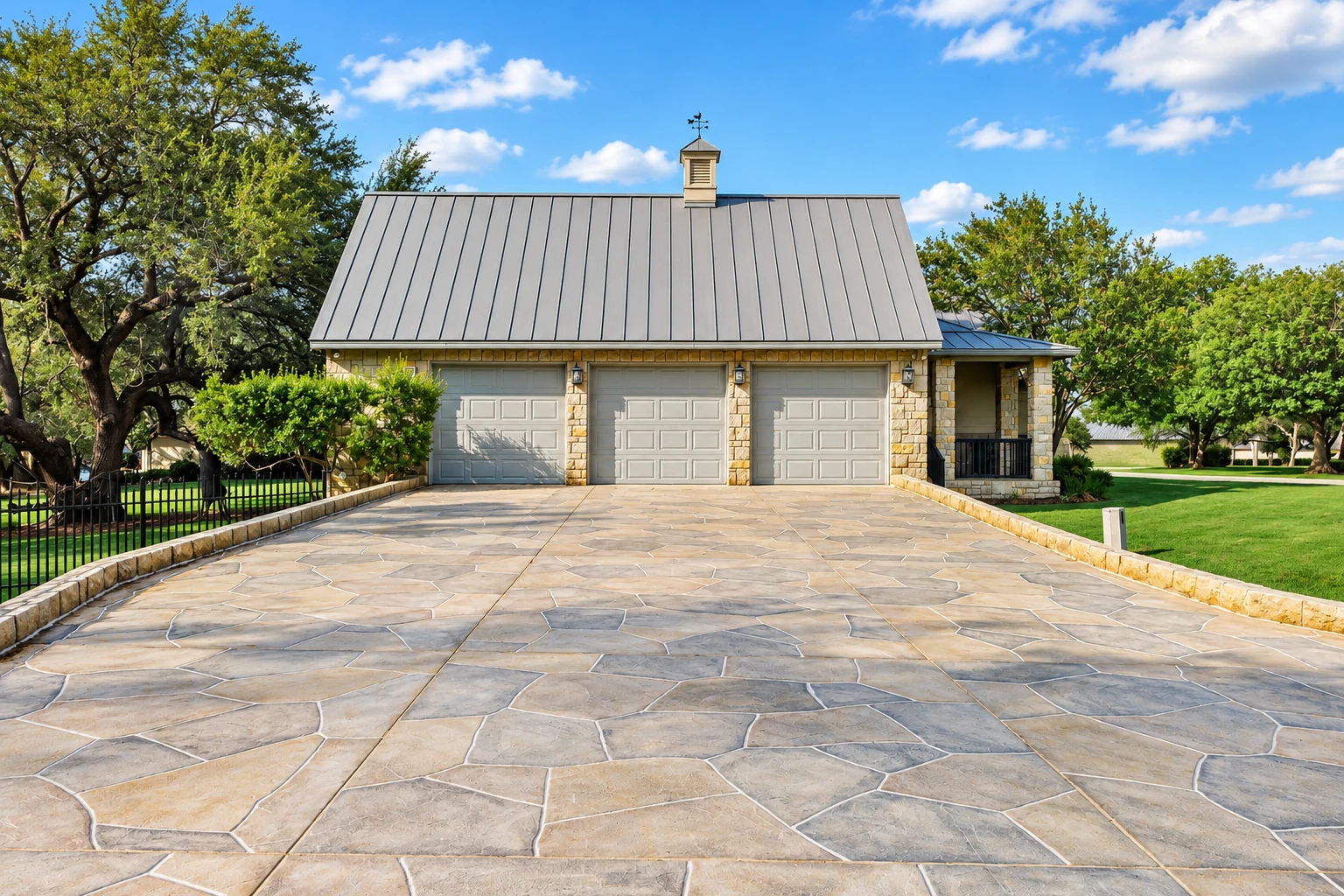
Decorative concrete in Alhambra CA - a patterned, colored surface on a sound slab
Plain gray slab or a worn, faded patio? We check what's underneath, then give it color and pattern that fit how you use it.
- Licensed and fully insured.
- Free on-site estimates.
- We respond within 1 business day.
Can you add color and pattern to the concrete you already have?
Decorative concrete in Alhambra usually means stamped concrete. That's poured concrete that's colored, pressed with rubber mats while it's still soft and then sealed, so one surface takes on the look of stone, brick, wood or tile. On a slab that's still solid, an overlay can give you that look without tearing anything out.
Most people who call have a plain gray patio, walk or driveway they're tired of looking at, or an older stamped slab that's lost its color. The price mostly turns on the size of the area, whether we're overlaying what's there or tearing it out for a new concrete patio, and the pattern and color method you pick. The schedule turns on that same choice, on whether a permit is involved and on curing, the wait while new concrete hardens before you use it. I put each of those on the written estimate, so you see where the money goes before anything gets poured.
How do you know your concrete is ready for color or a new surface?
Color faded to chalky gray
An older stamped patio that looks washed out usually means the sealer has worn off and sun and foot traffic are now working on the surface itself. Left alone, the wear goes into the color, and what could have been a reseal turns into a recolor or a new surface.
Cracks that go clean through
A crack you can see down the edge of the slab, or one where the two sides sit at different heights, usually means the slab or the ground under it is moving. That's past what a new top layer can cover, and the longer it moves, the more of the slab has to come out.
Flaking or a dusty top
If the top layer is scaling off or leaves grit on your shoes, the surface is weak even when the slab under it is fine. That's often a good candidate for a new surface, but waiting lets the flaking spread and makes the patches harder to blend.
How we handle decorative concrete, from slab check to sealer
I start by looking hard at the slab you have, because a new top won't fix a slab that's moving or broken through, and if it's sound, we match the color method to how the surface gets used. When it has to come out, we break it up, dig out and pack the subgrade, the ground the slab sits on, and check where the water runs so the new slab falls away from the house. We set the thickness and the rebar, the steel that keeps cracked pieces from pulling apart, for what the slab has to carry, and we pour in the cooler part of the day so the top doesn't come out weak and dusty. We press the pattern in while the concrete is still soft, cut control joints, shallow grooves that give the slab a straight place to crack instead of a random one, and seal it once it's cured. If the budget gets tight, I'll simplify the pattern before I'll cut the base, because you see the pattern on day one but the base decides whether the whole thing settles with the dirt.
Decorative work usually sits next to other concrete. If your patio steps down a slope, concrete retaining walls hold the grade so the new surface has stable ground at its edge, and if you want color inside a garage or an addition, it starts with a properly built slab through our concrete floor installation.
Integral color, mixed all the way through
The color runs the full depth of the slab, so a chip shows the same color instead of gray. It suits patios and walks, where a nick here and there is more likely than heavy wear.
Color hardener, worked into the top
Hardener gives a richer color and a harder skin on top, which is why it's the common pick for driveways. The trade-off is that a deep gouge shows the gray concrete underneath.
Get a written estimate for your decorative concrete
Send the form and we'll reply within one business day to set a time to look at your slab. The estimate is free, done on site and obligation-free, and it lists each part of the job.
(626) 597-0288- Based in
- Alhambra, CA 91801
- Hours
- Mon–Fri: 8 AM–10 PM, Sat–Sun: 7 AM–9 PM
What happens after you call about decorative concrete?
Here's how a decorative job runs from your first call to the final walk-through, and who you'll be dealing with at each step.
Call or send the form
Tell us roughly what you want covered and what's there now. We set a time for me to come out.
I measure and ask questions
I measure, check whether the slab is sound and ask what the concrete has to carry and what's going on top of it. You get a written estimate listing each part of the job, so you can compare bids line by line, and if a permit's involved we take care of it.
Our crew forms and pours
Our crew does the forming, pouring, stamping and finishing, and I'm on site on pour day checking the work as it goes. I'll tell you when the slab is ready to walk on and when it's ready to drive on, since curing decides both.
We walk the job together
When we finish, I walk the job with you before we call it done. That's the time to point at anything you want looked at again.
Why Alhambra homeowners call Optimum Alhambra Concrete for decorative work
The owner measures your job
I come out myself to walk the job and take measurements, and I'm there checking the crew's work as it goes. You're dealing with the person responsible for the result from the first visit on.
Commercial crew habits, since 2023
I spent years on commercial crews where every pour got checked against the plans before the truck backed in, and I started this business in 2023 to bring that care to homes. On a decorative job, that means layout and base get checked before any color comes out.
Licensed and fully insured
We're licensed and fully insured, and California's license law is what covers a contractor who forms, pours and finishes concrete. That matters here because in Alhambra only licensed people, or people the state law exempts, can pull a permit for work the code regulates.
If you're weighing an overlay against new concrete, the slab you have now decides it, so send us a few details or call (626) 597-0288 and I'll come take a look.
Decorative concrete, permits and older slabs in Alhambra
The city's Building Division requires permits for most residential construction on private property, and its list names things like patio enclosures, pools and sandblasting but not decorative concrete, so whether your job needs one is the city's call to make. If it does, we handle the application, keep the paperwork moving and let you know where things stand. If you pull an owner permit yourself, the city requires workers' compensation for anyone helping you, relatives and unpaid helpers included, though not you or immediate family living on the property. Work that reaches the sidewalk or the street goes through the city's Public Works Department, which reviews, inspects and permits projects in the public right-of-way.
A lot of what we see here is older patios and driveways that are still solid but plain or worn, which is exactly where the slab check matters. We do the same check before quoting color on jobs in Monterey Park and San Gabriel, and across the San Gabriel Valley.
Questions about decorative concrete in Alhambra
How much does stamped concrete cost in Alhambra?
Stamped concrete in the Los Angeles area usually costs about $15 to $30 per square foot, and that's the going rate for this work, not a quote from us. Where your job lands depends on the pattern, the color method, how much old concrete comes out and how much base work the area needs. Your written estimate breaks each of those out so you can see what you're paying for.
How do I know if my old concrete patio can be resurfaced instead of replaced?
An overlay works when your slab is structurally sound and can take a new layer bonded to it. If it's heaving, settling or cracked clean through, a new surface just sits on top of the problem, so the slab has to come out and be poured new. I check that on the first visit before suggesting either one.
How often should stamped concrete be resealed in the Los Angeles area?
Plan on resealing stamped concrete every two to three years around Los Angeles, because upkeep here is mostly about protecting the surface from sun and wear. Count that reseal in what the patio or driveway costs you over the years, not just what it costs on pour day.
Is stamped concrete slippery when it's wet?
It can be, and the usual cause is sealer put on too heavy. Installation guides call for two thin, even coats, because a thick flood coat bubbles, turns cloudy white and leaves the slab slick when wet. Ask any crew you're considering how they apply sealer, both on the first coat and on later reseals.
What causes blotchy color on stamped concrete?
Blotchy color usually comes from color hardener that wasn't spread and floated in evenly, since floating, smoothing it into the wet surface by hand, is what sets the color. Before you hire anyone, ask to see their finished hardener work so you can judge how even their color comes out.
Do I need a licensed contractor for a small concrete job in California?
Yes, unless the job is minor. California lets an unlicensed person take work only up to $1,000, and only when it needs no permit and they employ no one. Anything bigger, anything that needs a permit or any job with a hired helper calls for a licensed contractor.
Concrete work that often goes with decorative jobs
Concrete retaining walls
When the yard slopes toward your patio, a retaining wall holds the soil back so the decorative surface sits on level, stable ground.
Concrete floor installation
For a garage, shop or room addition, a new interior slab poured to the right thickness gives you a floor that's ready for color or a finish.
Service areas we cover from Alhambra
Optimum Alhambra Concrete is based in Alhambra, CA, and works across the San Gabriel Valley. Rosemead and Pasadena are two of the 12 cities with their own page here, and we take jobs in the cities around them too.
Alhambra, CA
Find out if your slab can take color
Have the rough size of the area, a few photos of the slab you have now and how far it sits from the sidewalk ready, so one call can sort out whether an overlay is worth a look and whether the street side gets involved.